
How to Choose a Kitchen Knife Set You'll Actually Use
A good kitchen knife can make everyday cooking feel much easier. Chopping vegetables, slicing meat and preparing ingredients are all part of the routine, so having the right knife for the job matters.
But choosing a new set can be confusing. There are different blade shapes, materials, handle designs and set sizes, and a larger collection doesn't necessarily mean better value.
If you're researching how to choose a kitchen knife set, the best place to start is with the meals you actually prepare. There's little point buying a collection full of specialised knives if you only reach for the same two every day.
Here's what to look for before making a decision.

1. Start with the way you cook
Before comparing knife sets, think about what happens in your kitchen during a typical week.
Do you prepare lots of vegetables? Cook meat regularly? Bake bread? Enjoy making more elaborate meals on weekends?
Your cooking habits will help determine which knives are most useful.
For example:
-
If you prepare salads and vegetable dishes often, a reliable chef's knife and smaller utility knife are useful.
-
If you regularly bake bread, a serrated bread knife can make slicing easier.
-
If you prepare whole cuts of meat, a slicing or carving knife may be useful.
-
If you work with smaller ingredients, a paring knife can offer more control.
Think about your current knives, too. Which ones do you use most often? Which tasks feel awkward with the knives you already own?
A useful set should solve real kitchen problems, not simply look impressive in a drawer.
2. Which kitchen knives do you actually need?
Different knives are designed for different tasks. Understanding the basics makes it easier to compare a knife set.
Chef's knife
A chef's knife is one of the most versatile kitchen tools. It can be used for chopping vegetables, slicing meat, mincing herbs and handling many everyday preparation tasks.
If you only buy one full-sized kitchen knife, this is often a sensible starting point.
Bread knife
A bread knife has a serrated edge designed to cut through crusty bread without crushing the softer centre.
It can also be useful for slicing certain soft-skinned foods, depending on the knife and ingredient.
Slicing knife
A slicing knife is designed for longer, controlled cuts. It can be useful when preparing roasts, cooked meats and other larger pieces of food.
Cleaver
A cleaver has a broad blade and is commonly used for chopping and preparing larger ingredients. Its suitability depends on the blade construction and intended use.
Not all cleavers are designed for cutting through bones, so check the manufacturer's instructions.
Japanese-style knife
Japanese-style knives come in several forms and can be designed for slicing, chopping or more specialised preparation tasks.
The name alone doesn't tell you everything about a knife's performance. Blade shape, weight, construction and intended use are all worth checking.
Boning knife
A boning knife is designed for working around bones and separating meat from them. Its narrower blade allows more controlled movement for certain preparation tasks.
Utility knife
A utility knife sits between a small paring knife and a full-sized chef's knife. It's handy for everyday jobs such as slicing fruit, trimming vegetables and cutting smaller ingredients.
Paring knife
A paring knife is a small kitchen knife suited to detailed work, such as peeling, trimming and preparing smaller fruits and vegetables.
3. What to check when comparing knife materials
The blade material affects how a knife performs and how it needs to be maintained.
Stainless steel
Stainless steel is popular because it offers corrosion resistance and is available in a wide range of kitchen knife designs.
However, stainless steel knives still need proper cleaning, drying and sharpening.
High-carbon steel
High-carbon steel is valued for its ability to take a sharp edge. Depending on its composition and finish, it may require more careful maintenance to reduce staining or corrosion.
Damascus-style blades
Damascus-style blades are recognised for their distinctive layered appearance.
The appearance can be attractive, but don't choose a knife based on the pattern alone. Check the actual blade material, construction and care instructions.
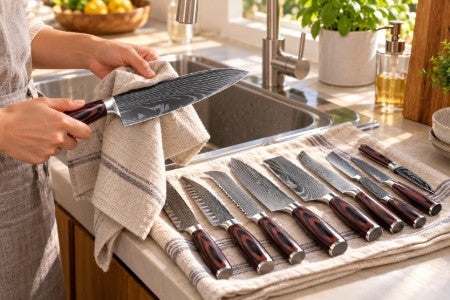
The ProChef 8 Piece Japanese Knife Set is listed by Hive & Hush as featuring high-carbon Damascus steel blades and wooden handles.
Precision Culinary Tools
4. Don't overlook the handle
The handle is just as important as the blade.
A knife should feel comfortable and controlled in your hand. Consider:
-
Whether the handle feels secure.
-
Whether its size suits your hand.
-
Whether the knife feels balanced.
-
Whether the grip remains comfortable during longer preparation tasks.
-
Whether the material is easy to clean and maintain.
If possible, handle a similar knife before purchasing. A design that feels comfortable to one person may not feel right to another.
Also remember that sharp knives require careful handling. Store them securely, keep fingers clear of the cutting edge and use a stable chopping board.
5. Knife set vs individual knives: which is better?
Buying a complete set can be convenient, but purchasing individual knives may be more practical for some kitchens.
|
Buying a set |
Buying individual knives |
|
Convenient way to get several knife types |
Lets you choose only what you need |
|
Can offer a consistent look and design |
Allows you to prioritise specific tasks |
|
May provide better value as a bundle |
Can spread the cost over time |
|
Some knives may rarely be used |
Less unnecessary equipment |
|
Useful for setting up a new kitchen |
Useful when replacing one worn knife |
If you're starting from scratch or replacing several old knives, a set can be a sensible option.
If you already own a good chef's knife and bread knife, you may only need to replace one or two items.
6. What comes in the ProChef 8 Piece Japanese Knife Set?
The ProChef 8 Piece Japanese Knife Set includes eight knives:
-
1 × 8-inch chef knife.
-
1 × 8-inch bread knife.
-
1 × 8-inch slicing knife.
-
1 × 7-inch cleaver knife.
-
1 × 7-inch Japanese knife.
-
1 × 6-inch boning knife.
-
1 × 5-inch utility knife.
-
1 × 3.5-inch paring knife.
The product page lists high-carbon Damascus steel and wooden handles. This range covers several everyday preparation tasks as well as more specialised cutting jobs.
Precision Culinary Tools
Product image placement: Use the official ProChef product image showing the full eight-piece set. Add the close-up blade image and handle image from the product gallery further down the article.
7. How to choose a kitchen knife set as a gift
A kitchen knife set can be a useful gift for someone who enjoys cooking, is setting up a new home or is upgrading their kitchen essentials.
Before buying one as a gift, consider:
-
Their cooking habits: Do they cook regularly or mostly prepare simple meals?
-
Their current equipment: Are they starting from scratch or replacing older knives?
-
Storage: Do they have suitable drawer space or a knife storage solution?
-
Maintenance: Are they comfortable sharpening and caring for kitchen knives?
-
Set size: Would they use all the knives included?
A larger set may look impressive, but the most thoughtful gift is one that fits the recipient's cooking style.
8. How to care for your kitchen knives
Even good-quality knives need regular care.
A few simple habits can help keep them in better condition:
-
Follow the manufacturer's cleaning instructions.
-
Dry knives thoroughly after washing if hand-washing is recommended.
-
Use a suitable chopping board.
-
Avoid using kitchen knives on unsuitable materials, such as glass or stone.
-
Store knives securely to protect the blades.
-
Sharpen them when needed using an appropriate method.
Never leave loose knives in a crowded sink or drawer. This can damage the blades and create an unnecessary safety risk.
Frequently asked questions
How many knives should a kitchen knife set have?
There isn't a perfect number. Most home cooks benefit from a chef's knife, bread knife and paring knife as a starting point. Additional knives depend on cooking habits.
Are Japanese-style kitchen knives good for everyday cooking?
They can be, depending on the design and intended use. Check the blade shape, weight, handle and care requirements rather than choosing based on the Japanese-style label alone.
Is a Damascus steel knife better?
Not automatically. Damascus-style construction and appearance are only part of the picture. The underlying materials, blade construction, sharpening and maintenance all matter.
Should kitchen knives go in the dishwasher?
Follow the manufacturer's instructions. Hand-washing and drying are often recommended for quality knives because dishwasher detergents, heat and movement can affect blades and handles.
What is the most useful knife in a kitchen?
For many home cooks, a chef's knife is the most versatile. However, a bread knife and paring knife are also useful additions.
Choose a knife set that suits your kitchen
The best kitchen knife set is one that matches the way you cook. Consider the knife types, materials, handle comfort and care requirements before deciding.
If you're looking for a collection that covers several everyday kitchen tasks, explore the ProChef 8 Piece Japanese Knife Set.
You can also browse the Hive & Hush Home & Living collection for more practical kitchen and household essentials.


Leave a comment
This site is protected by hCaptcha and the hCaptcha Privacy Policy and Terms of Service apply.