
You've finally made it to the hotel after a long travel day. The kids want to watch something, your phone is on 4%, the tablet is flat, and there's exactly one power point hiding behind the bedside table. Sound familiar? When your phone holds your boarding passes, maps, bookings and holiday photos, a flat battery can turn a lovely trip into a stressful one.
With the summer holidays and Christmas travel just around the corner, now is a great time to get your charging sorted. This guide on how to keep your phone charged while travelling shares easy habits, packing tips and a few smart settings, so you can spend less time hunting for power points and more time enjoying the trip.
Quick answer: To keep your phone charged while travelling, charge every device fully the night before you leave, turn on low power mode, download maps and entertainment before you go, carry a power bank in your hand luggage, pack the right plug for your destination and use a multi-port travel adapter so the whole family can charge from one power point overnight.

Why Your Phone Runs Flat Faster When You Travel
At home, your phone sits on a charger most nights and you barely think about it. On holiday, it works much harder. You're using maps all day, taking photos and videos, searching for places to eat, checking flights and messaging family back home. If you're in an area with weak signal, your phone also works harder to stay connected, which can drain the battery faster.
Add in a hotel room with one spare power point, a plug that doesn't fit overseas sockets and a few family members all needing a charge, and it's easy to see why so many of us end up hunting for power at the airport café.
10 Ways to Keep Your Phone Charged While Travelling
1. Start Every Travel Day at 100%
Charge phones, tablets, headphones and power banks the night before you fly or drive. Make it part of your packing routine so nobody leaves home half charged.
2. Turn On Low Power Mode Early
Most phones have a low power mode or battery saver. Switch it on as soon as you leave home rather than waiting until you're down to 10%.
3. Download Before You Go
Download offline maps, playlists, podcasts and the kids' shows on home Wi-Fi before you leave. Streaming on the go uses more battery (and data).
4. Dim the Screen
Your screen is one of the biggest battery users. Lower the brightness and shorten the auto-lock time to help your charge last longer.
5. Close Apps You're Not Using
Turn off background refresh for apps you don't need on holiday, and switch off Bluetooth when you're not using headphones.
6. Use Flight Mode in Weak Signal Areas
On a plane, on remote roads or in the countryside, flight mode stops your phone from constantly searching for a signal. You can still turn Wi-Fi back on if it's available.
7. Pack a Charged Power Bank
A power bank is your backup for long days out. Keep it in your hand luggage rather than checked bags, and check your airline's rules before you fly. When choosing one, CHOICE's testing of power banks that don't live up to their claims found big gaps, and their advice is: "Before you buy, make sure you check each product's actual charge capacity so you know what to expect."
8. Keep Cables Together
Pop every charging cable into one small pouch in your carry-on, so you're not digging through the suitcase at the hotel.
9. Charge Whenever You Can
Top up during breakfast, in the car or at the airport gate. A few short top ups through the day add up.
10. Set Up One Charging Station
As soon as you arrive, choose one spot in the room for charging. Every device goes there at night, so everyone wakes up with a full battery and nothing gets left behind at checkout.

Charging Overseas: Plugs, Sockets & Voltage Labels
If you're heading overseas these holidays, your Australian plugs won't fit many power points around the world. Europe, the UK and the USA all use different socket shapes, so you'll need a travel adapter that fits.
It also helps to understand what an adapter does. A travel adapter changes the shape of the plug so it fits the local socket. It doesn't change the voltage. Before you plug anything in overseas, check the small print on your charger or device label. Many phone and laptop chargers say something like "100 to 240V", which means they're designed for a wide range of voltages. If a device (like some hair tools) only lists a single voltage, check with the manufacturer before using it overseas.
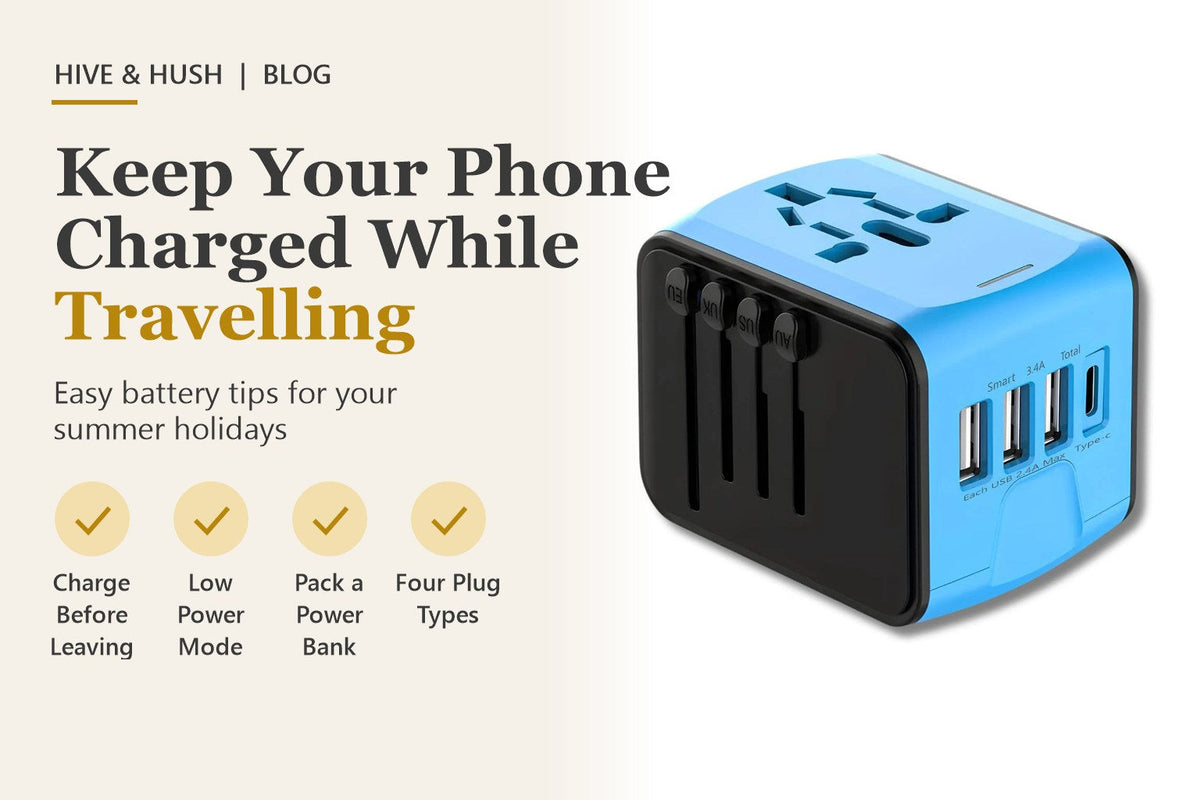
The ProCharge Worldwide Travel Adapter has four plug types built in (EU, UK, US & AU), which slide out when you need them. It also has 3 USB-A ports, 1 USB-C port and 1 AC outlet, so you can charge up to five devices at once from a single power point. It's compact and comes in blue, black, white or lime green, so it's easy to spot in your bag.
Keeping the Whole Family Charged in One Hotel Room
Family holidays mean a lot of devices: phones, tablets, headphones, a camera and maybe a smartwatch or two. Hotel rooms, holiday rentals and cabins often have only a couple of free power points, and they're rarely where you need them.
- Agree on a charging spot: one table or bench where everything charges overnight.
- Take turns: charge the devices you need first thing (phones and the power bank) before the extras.
- Label cables: a little coloured tape helps the kids find their own cable.
- Keep it tidy: keep cords away from walkways and out of reach of little ones.
- Do a final sweep: check every power point before checkout. Chargers are one of the easiest things to leave behind.
Road Trips, Flights & Long Travel Days
On a road trip, use the car charger while you drive, and plug in the power bank too, so it's ready for the next stop. On a flight, check whether your seat has a USB port, but don't rely on it. Bring your own charged power bank and keep your phone in flight mode for most of the trip.
If you're travelling over Christmas, airports and service stations can be busy, and free charging spots fill up fast. Having your own charging plan means one less thing to worry about.

What to Look for in a Travel Adapter
- The right plug types: ProCharge has EU, UK, US & AU plugs built in.
- Enough ports: 3 USB-A, 1 USB-C and 1 AC outlet for up to five devices at once.
- USB-C: handy for newer phones, tablets and some laptops.
- Compact size: one adapter instead of a bag full of plugs.
- A colour you'll spot: blue, black, white or lime green.
- Check your labels: make sure your own devices suit the voltage at your destination.
Your Travel Charging Checklist
- Charge every device and power bank the night before
- Download maps, music and shows on home Wi-Fi
- Turn on low power mode when you leave
- Pack the power bank in your hand luggage
- Pack all cables in one pouch
- Pack a travel adapter for your destination
- Check device labels for voltage before going overseas
- Set up one charging spot as soon as you arrive
- Check every power point before checkout
More Battery, More Hush
A flat phone is one of those small travel hassles that can throw out a whole day. With a few easy habits, a charged power bank and the right adapter, you can keep everyone's devices topped up and enjoy the holiday instead of searching for a power point. Start with one charging spot and a full battery each morning, and the rest gets much easier.
Find more ideas for an easier home and holiday in our Home & Living Collection, or see what other families love most in Hive Favourites.
At Hive & Hush, we're a veteran-owned family business from Perth, and you can read our story anytime. Every order comes with fast & free shipping, free return shipping Australia & NZ wide (including change of mind) and a 30 day money back guarantee on unused, resalable items. If something isn't right, we'll make it right.
Shop the Travel Essentials
Shop the ProCharge Worldwide Travel Adapter
Sources
From The Hive
FAQ
How can I keep my phone charged while travelling?
Charge everything before you leave, turn on low power mode, download maps and shows in advance, carry a charged power bank in your hand luggage and use a travel adapter that fits local sockets.
Does a travel adapter convert voltage?
A travel adapter changes the plug shape so it fits the socket. Check the label on your charger or device for its voltage range before you plug in overseas.
Can I take a power bank on a plane?
Power banks generally need to go in your carry-on, not your checked luggage. Check your airline's rules before you fly, as limits can vary.
How many devices can I charge with ProCharge?
Up to five at once, using its 3 USB-A ports, 1 USB-C port and 1 AC outlet.
Which plug types does ProCharge have?
It has four built-in plug types: EU, UK, US and AU.
What colours does ProCharge come in?
Blue, black, white and lime green.



Leave a comment
This site is protected by hCaptcha and the hCaptcha Privacy Policy and Terms of Service apply.